

Hello there. I appreciate your readership and connection.
In honor of this post’s topic and intention, I have a request. Can you help me support my friend Osayd Alkurd, so he can escape Gaza (Palestine) to go and study data science in Italy? The full story is on his campaign page - I am running and managing it - on Chuffed.org here.

If you are looking for a worthy cause and are able, any of your support would be an incredible gift.
Click here to donate on Chuffed.org and thank you.
A Small Cognitive Shiver
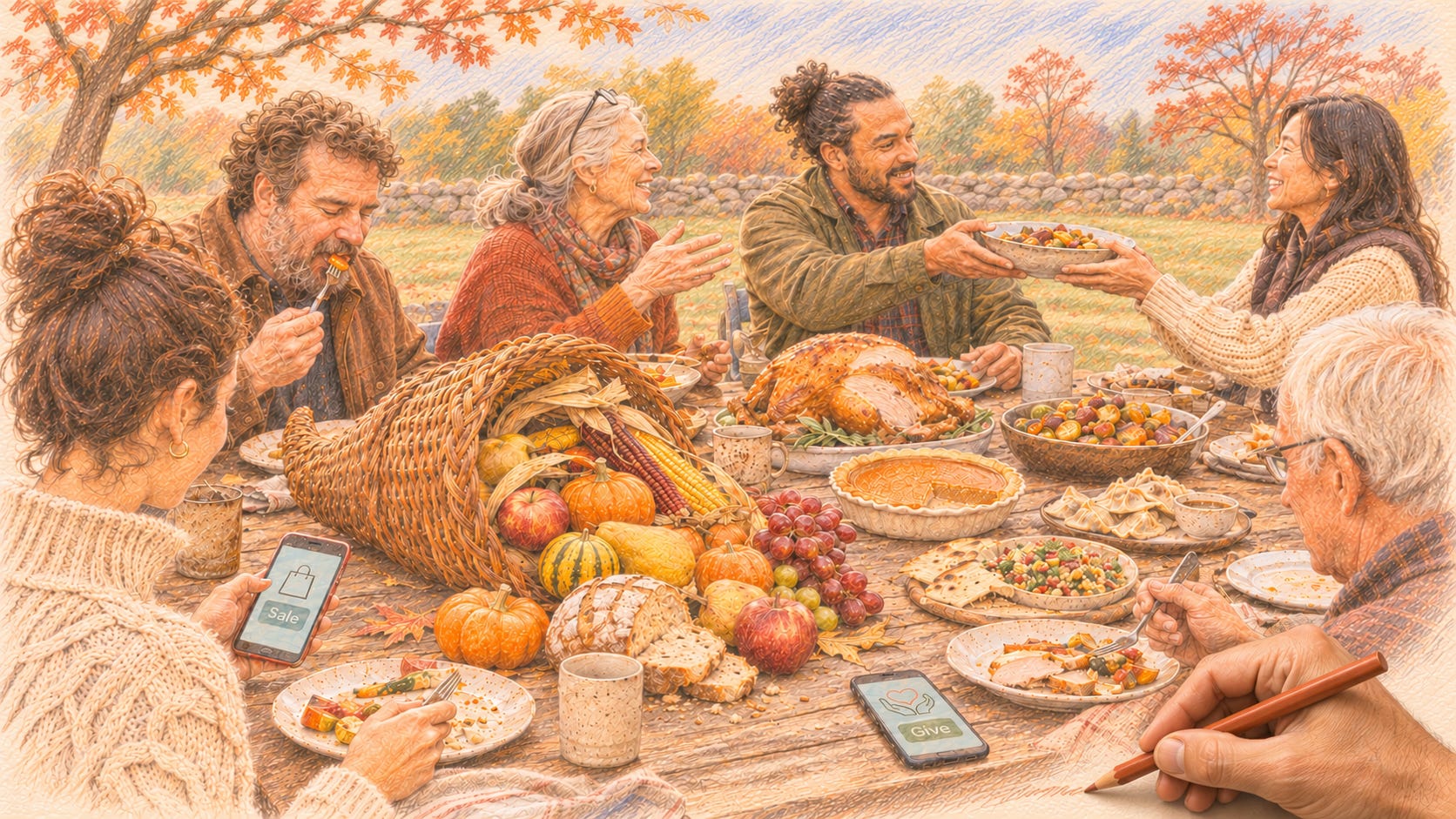
Last year in 2025, after sitting and eating Thanksgiving dinner with my family, I had one of those moments where I was suddenly seeing that weekend with clarity. It was because I was wondering… how did Black Friday, Cyber Monday, etc. come to be a thing? As I pondered more, I felt a small cognitive shiver - like, why hadn’t I ever questioned that before?
Thanksgiving is supposed to be about giving of thanks, giving, and thanks. That includes good feelings and experiences, like gratitude, a pause, a breath, a reckoning with what already is, etc. - yet it is a holiday surrounded by “the need to acquire more” followed by a day of… “making up for it” by donating to charity? That’s a pretty negative take on it… so I hope it isn’t the case.
Thanksgiving has long been a favorite holiday because I enjoy spending time with my family. I enjoy the ritual as much as anyone. But noticing a specific sequence of four days (starting on Thanksgiving) has made me become curious and a little suspicious of what I was not paying attention to.
This post is not intended as a complaint about commerce and capitalism.
It is, however, definitely me taking a moment to pause and question.
I love language and words. Language is not decoration - it’s the architecture of meaning. So, the words we attach to our rituals don’t just describe them. They can shape what we expect to feel, how we behave, and what we believe the occasion is for.
To explore this deeper, we need to take a step backward.
The Story of Thanksgiving
Thanksgiving’s story has always been presented to me as kinder and gentler than the history that underlies it. The feast most Americans imagine, with tables joined, goodwill exchanged, and gratitude offered in unison, is a retroactive narrative, polished long after the fact.
According to what I read - the actual 1621 encounter between the English settlers and the Wampanoag people was not a national covenant so much as a fragile, strategic moment shaped by disease, diplomacy, and competing interests. The Smithsonian’s National Museum of the American Indian offers a much more complicated account of the event, including the devastating consequences of colonization and the way the familiar Thanksgiving story was constructed centuries later.
It is also worth remembering that Indigenous peoples had their own traditions of gratitude and harvest celebrations long before the English arrived. The settlers did not invent the idea of giving thanks.
It’s when my mind and my research start wandering down these paths, where I realize that maybe the way I know it isn’t really how it was… that I start to become uncomfortable.
None of this invalidates the holiday or the genuine meaning people find in it today. It’s just a reminder that Thanksgiving has always been doing cultural work: it can wrap some really complex history in the warm language of gratitude.
In that sense, perhaps the holiday’s modern evolution is an example of how the stories surrounding our rituals change - or are changed. Narrative control is a real thing. We know this.
Our rituals have always been stories we tell ourselves about who we are…
even when the story is more aspirational than descriptive.
Which brings us to the sequence that now defines late November. Four days, four terms, each carrying suggestions about what we should do and value.
Once you notice the structure, an interesting emotional pattern begins to emerge.
Thanksgiving 🦃: The Ritual of Enoughness
Thanksgiving seems to be a remarkably complete word. “Thanks” implies receipt: something was given, something arrived, something exists that we did not create alone. “Giving” implies an outward expression of appreciation. In a single compound word, we find a moral circuit: receive ➡️ reflect ➡️ respond.
It is, interestingly, the only one of the four days that asks nothing more of us than presence (well, and potentially a significant amount of cooking, baking, and eating).
Black Friday ⬛️: The Ritual of Urgency
For many years, it used to be that the morning after Thanksgiving, everything changed. Not necessarily in our circumstances, but certainly in the language surrounding us. Although in 2026… Black Friday starts days before even Thanksgiving now.
If you’ve noticed that Thanksgiving seems to start in stores (and spirit) around you before Halloween arrives, and Christmas seems to start around Thanksgiving, you’re not the only one.
Black Friday - surprisingly or not - has a history that is not especially cheery.
I had to Google it.
The phrase was used to describe the September 24, 1869 collapse of the American gold market, following an attempt by financiers Jay Gould and James Fisk to manipulate gold prices. The resulting financial panic caused enormous losses. Yikes.
That wasn’t the origin of the shopping holiday though.
The modern use of Black Friday seems to trace back to Philadelphia in the 1950s and 1960s, where police used the term to describe the extraordinary traffic, crowds, and general chaos that descended on the city the day after Thanksgiving, particularly around the annual Army-Navy football game.
According to the Associated Press’s account of the term’s history, it was not originally intended as a celebration of retail success. Quite the opposite. It described a challenging day for the people responsible for keeping the city functioning. Sounds familiar, actually.
Retailers eventually embraced the name and helped popularize a more positive interpretation: the day when businesses supposedly moved from operating at a loss, or “in the red,” to making a profit, or “in the black.”
That explanation makes for a good story, but it is also not the historical origin of the shopping-related term.
I find this fascinating. The same two words have been used to describe financial catastrophe, public disorder, and one of the most “important” shopping events of the year. The history might not be one continuous story, but the degree to which those words have had different meanings is striking.
There's another “black” day worth mentioning, one that happens to have a rather unusual personal connection for me. On October 19, 1987, my sixth birthday 🎂, stock markets around the world crashed (it wasn’t my fault, I promise). That day became known as Black Monday, when the Dow Jones Industrial Average lost an astonishing 22.6% of its value in a single trading session.
I thought Black Friday was borrowed from Black Monday - but it turns out, that is not the case. According to Oxford Dictionaries, we’ve been attaching the word “black” to particularly unfortunate days for centuries. Both belong to a long tradition of naming days associated with disaster, misfortune, or disruption.
Black is already one of the most symbolically loaded adjectives in English. It has marked catastrophe (“Black Death”), financial ruin (“Black Thursday”), and other events considered particularly dark or unfortunate. Yet in business accounting, being “in the black” signifies financial health and profit. How the heck did that happen?
I have to admit, the longstanding use of “black” to describe something bad, dangerous, or unfortunate makes me uncomfortable, particularly given the racial tensions surrounding the word in American culture. I know these expressions weren’t necessarily intended as racial references, and I don’t interpret them that way myself. But that doesn’t mean someone else won’t, or hasn’t. Words carry associations we may or may not intend, and those deserve consideration too. Language is hard.
I can appreciate that the intention is to spend money so that we do have a strong economy. What interests me is how that same language, once used to signal something to dread, has been transformed into something we’re encouraged to celebrate, participate in, and spend money on. Our obligation should not be to prop up the economy, but to participate when it is meaningful to us - that’s a really big difference.
Meanwhile, we have “Friday”. I have never forgotten that there used to be a segment on TV back when I was a kid in the 90s called “TGIF” - Thank Goodness it’s Funny! Before the TGIF acronym was commandeered for television, it was “Thank God it’s Friday” - the threshold between labor and leisure, the loosening of restraint. People working 9-5 Monday through Friday couldn’t wait to get out of work on Friday. As a word, and an emotion, Friday pulses with perceived freedom and excitement of the weekend to come.
Oddly, have you ever noticed the visceral vocabulary of the Black Friday shopping event, that reinforces some of the darker meanings? For example:
“Doorbusters” (violence)
“Prices slashed” (wounds)
“Limited quantities” (scarcity)
The emotional register pivots from sufficiency to fear of missing out. Gratitude, a state of rest, gives way to motion. The ritual that told us we had enough now prepares us to acquire. Don’t just be happy the weekend is coming, go spend MONEY and buy STUFF!
A phrase once used to describe the negative consequences of extraordinary commercial activity has become one of the most recognizable invitations to participate in it.
Cyber Monday 💻: The Ritual of Optimization
If Black Friday celebrates the hunt, Cyber Monday doubles down on it.
Some more Googling and ChatGPT’ing later - I discovered the following: unlike Thanksgiving or Black Friday, we can identify the modern marketing origin of Cyber Monday quite precisely.
One of the people involved in creating the term, Ellen Davis, later described how Cyber Monday emerged from a small marketing brainstorm.
The term was introduced in 2005 by Shop.org, the online retail division of the National Retail Federation. Retailers had noticed increased online shopping/eCommerce on the Monday after Thanksgiving, partly because people were returning to workplaces with faster internet connections than they had at home. The organization gave the phenomenon a name, and it caught on remarkably quickly.
Cyber Monday was also usually, mostly tech forward. Cyber once evoked futurism and power; it also suggests systems, efficiency, networks, and even things that bring us daily concern - such as cybersecurity, cyber warfare, etc.
Bottom line… “cyber” means another reason to buy/spend money on stuff, especially for the tech-savvy consumer!
Monday is the workweek reset, the day of productivity, identity, and effort. Monday is also a day of dread (along with the “Sunday scaries”) about returning to work,
perhaps to be quenched by the joy of upgrading one’s technology? Ahh.. sweet distraction.
Cyber Monday reframes consumption: you are not merely buying, you are upgrading and becoming more efficient! You are not spending; you are optimizing. The messy desire of Black Friday is replaced with a rational justification.
It will be interesting to see how sales pan out this Cyber Monday, along with what is being sold, because between shortages of tech stuff, the general feeling towards tech companies, and how much everything costs vs. how many people lost their jobs, and how society is changing… I’m not sure.
There is no mythic feast here, no communal table, only an inbox full of algorithmic recommendations fine-tuned to your predicted self.
If Thanksgiving told us we have enough, and Black Friday told us to get out there and hit the sales and get all the goodies, Cyber Monday tells us we always need yet one more thing.
Giving Tuesday 🙏: The Ritual of Generosity
Then comes a curious return of a familiar word: giving. This time, it is embodied in the event Giving Tuesday. It’s almost like a giving sandwich.
But notice what’s different?
Thanksgiving names the act of giving thanks. Giving Tuesday invites us to give something of ourselves. And I can’t help wondering whether we’ve put these things in a rather peculiar order. Does generosity naturally follow consumption, or have we simply found another convenient moment to ask people for something?
Why didn’t giving come first? It arrives after the taking, not before it.
More Googling….
Giving Tuesday was created in 2012 at New York City’s 92nd Street Y as an initiative to encourage generosity and doing good. It has since grown into an international movement that encourages giving throughout the year.
And here’s something I particularly appreciate - Giving Tuesday’s own mission emphasizes empathy, solidarity, and shared humanity, rather than simply treating generosity as a series of transactions.
It’s not just about donating money. The movement encourages giving time, sharing skills, volunteering, helping neighbors, and performing acts of kindness.
I think that’s genuinely wonderful, and I want to encourage people to participate. If you can, I’d be honored if you’d help me support my friend Osayd, but there are so many valid causes.
If you have the resources and there’s a cause or organization you believe in, consider supporting it - any time of the year. If money is tight, perhaps you can offer some time, share a skill, help a neighbor, or simply show someone that they matter.
For me personally, the nature of giving has changed. I don’t look at it entirely as charity anymore, nor do I necessarily think about solving all the world’s problems. I wish I could - but instead I look more to places, causes and people with which I can personally move the needle. While I still donate to larger charities, my current pragmatic theory is that helping even one person directly and making a real difference matters - if that helps them to go on to help someone else, even better.
The placement of Giving Tuesday in the calendar is still weird to me. After Black Friday and Cyber Monday, Giving Tuesday offers an opportunity to redirect some of our attention toward others. Is it meant to be a chance to balance the ledger, to offset the excess, to restore a sense of moral symmetry? Do we do it.. out of guilt?
It can become an answer to a question the holiday weekend has encouraged us to ask: Have I taken too much?
Of course, giving need not come from guilt. It can come from love, gratitude, compassion, or a genuine desire to improve someone’s life. The distinction matters.
My concern isn’t with Giving Tuesday itself. It’s with what can happen when even generosity becomes another occasion to compete for our attention and money.
There is a meaningful difference between inviting someone to give and making them feel obligated to do so.
I’d much rather see Giving Tuesday as a reminder of what we can contribute to one another, freely and willingly, than another obligation on an already crowded calendar.
Perhaps that’s the better way to understand it. Not as a day to make up for what we’ve taken - but more as an opportunity to recognize what we have to give. Perhaps, as a day to contemplate how we can be giving and supporting and helping each other, throughout the coming years.
It’s not easy to live your life that way, so spending time thinking about how to do it? Sounds like a solid plan to me.
Putting It All Together
Four days. Four linguistic frames. One possible emotional trajectory:
Thanksgiving: Enough → Appreciate → I have
Black Friday: Scarcity → Acquire → I need
Cyber Monday: Optimization → Upgrade → I deserve
Giving Tuesday: Generosity or obligation → Give → I choose / I should
In four iterations of language, we can move from sufficiency to scarcity to indulgence to absolution. As a software engineer, I can’t help seeing something like an algorithm in that sequence.
But there’s another possibility: Giving Tuesday could interrupt that sequence rather than complete it. The same event can become an obligation or an opportunity. Perhaps the difference is in how we choose to participate.
Isn’t it interesting that different organizations, responding to different incentives, can almost accidentally create something that looks remarkably similar? It’s a response to something, that much is sure.
Once I saw all of this, I couldn’t unsee it.
I was sitting there at that Thanksgiving table in 2025, remarkably quiet (so my family tells me) and my mashed potatoes and turkey were getting cold while my head was spinning with all these thoughts.
I wouldn’t blame you if you thought me a bit… crazy.
A Hidden Clue in the Calendar
One more thing I noticed about this sequence, seemingly hiding in plain sight. Thanksgiving falls on Thursday, Black Friday on Friday, Cyber Monday on Monday, and Giving Tuesday on Tuesday.
What about Saturday and Sunday?
Well, it turns out those aren’t exactly left alone either.
More Googling…. yikes.
In 2010, American Express created Small Business Saturday, encouraging us to support independent businesses by shopping locally. I actually quite like the intention behind that one.
Then, in 2017, the Museum Store Association launched Museum Store Sunday to encourage shopping at museum stores and supporting the cultural institutions they serve. I love museum stores.
The Museum Store Association explicitly recognized that Black Friday, Small Business Saturday, Cyber Monday, and Giving Tuesday already occupied the surrounding days. Sunday was the remaining opportunity.
Perhaps it isn’t that the economic calendar has taken over the working week. It’s that the entire holiday period has become a collection of named occasions, each with its own purpose, sponsor, and invitation to participate. I’m tired.
Are these “economic holidays”?
I don’t think this requires some grand plan. Businesses and institutions already know that our collective attention is valuable, and apparently, that naming a day is a remarkably effective way to organize it.
But: who benefits from the way our collective attention is organized, and are those benefits ultimately healthy and shared?
The Pattern Expands: Enter Travel Tuesday 🏝️
Ok, by this point, I am sure you’ve had enough - but for completeness, one more.
The post-Thanksgiving sequence has begun to sprout new branches.
Travel Tuesday, also called Travel Deal Tuesday, was promoted by travel-booking platform Hopper beginning in 2017. In fact, Hopper’s original announcement explained that the company had analyzed historical airfare data and identified an unusual concentration of flight deals on the Tuesday after Thanksgiving.
In other words, it found a pattern in the market and turned it into a commercial, named shopping occasion. Creative… clever… sounds familiar.
Nearly a decade later, Hopper is still promoting Travel Tuesday, with airlines, hotels, and other travel businesses participating in the event.
And it happens on the very same Tuesday occupied by Giving Tuesday.
It’s not just products anymore. It’s experiences. It’s not just your wallet. It’s your aspirations. And each emerging “day” borrows a similar linguistic trick: attach a familiar weekday name to a sector, and suddenly the sector has its own ritual.
The days stop looking merely like holidays and start looking like slots in an economic calendar, each competing for your attention, your emotional bandwidth, and ultimately your money.
This is where the distinction becomes important. The work that charities and nonprofits do is generally very important to humanity. For donations to nonprofit organizations, resources like Charity Navigator, Candid, Give.org, etc. help you research who you’re supporting.
Organizations asking for support usually have the very best intentions. Yet the machinery of fundraising can begin to resemble the machinery of commercial operations, competing for the same finite attention and resources.
Travel Tuesday doesn’t replace Giving Tuesday. It crowds it. One asks us to purchase an experience, the other to support a cause. The purposes may be very different, but the competition for our attention and money looks increasingly similar.
The names change. The mechanism does not.
What Do We Do With This?
I’m not advocating that we abandon our rituals. I like Thanksgiving. I buy things. I’ve donated on Giving Tuesday. The point is awareness.
Commerce can create genuine value. A purchase can improve someone’s life. A business can make a reasonable profit while contributing to a better society. A donation can change someone’s future. There is nothing inherently wrong with any of these things.
I think businesses and organizations have an important responsibility to society that goes beyond simply maximizing revenue or profit. Economic activity should ultimately contribute to better lives, stronger communities, and better futures.
Efficiency and optimization are valuable tools. But they are tools, not ends in themselves. If we make something more efficient at the expense of the very human value it was supposed to provide, what exactly have we improved?
The question is whether the systems we build ultimately serve human well-being, or whether people increasingly find themselves serving the systems, or whether those very systems are extracting value and hollowing things out until there is nothing left.
Rituals shape us. Words guide us.
Every so often, it’s worth asking
whether the stories we tell ourselves still fit the lives we want to live.
Filling Everyone’s Cup
Perhaps the real opportunity buried in this long weekend is not the bargains or the causes, but a moment to notice the relationship between desire and meaning. There is a version of this season in which giving is a choice made from fullness, not a reflex triggered by imbalance.
Gratitude need not be a precursor to acquisition. Generosity need not be a solution for guilt.
If language can hollow out a holiday, it can also help us restore one.
So here is the question I’m left with, not as a challenge, but as a gift (because it helps me think about what matters):
What else in your life still carries the name, appearance, or ritual of something meaningful, but no longer delivers quite the same value? And what small choice could you make to begin filling it back up with the good stuff?
I only ask that we notice what we’ve traded away and decide how to put it back right.
If we can learn to recognize the places where our rituals serve us, and the places where we now serve them, we may find that the work of filling what has been hollowed out begins not with grand gestures, but with the smallest acts of kind human attention.
Author’s Note
I’ve spent the last few years trying to understand why so many things that once felt meaningful, including work, community, tradition, and even celebration, now feel thin or inverted, as though the form remains but the substance has quietly leaked out.
This essay is part of that exploration. My current professional work is growing out of a simple conviction: that it’s possible to build structures and practices that add meaning back into our lives instead of extracting it.
It is a hard problem. I am still working on it, and I have no desire to give up.
If something here resonated with you, consider this not an answer, but a beginning, an invitation to think about what deserves to be full again.
Giving Some Extra Thanks
This post was originally written in 2025. It took me a full year to edit & post it, because last year, I was a little scared to publish it. I didn’t want to ruin anyone’s holiday, sound negative or be controversial at a time that was meant to be joyful, restful and renewing.
In a wonderful spirit, my friend Lindsey Lerner posted an incredibly insightful message about the order/sequence of events involving Giving Tuesday, on LinkedIn (I encourage you to read it).

This prompted me to reconsider posting. Her positive intent and inspiration gave me the confidence to share this with you. Thank you, Lindsey (and Meghan too, who also encouraged me). 🌀